
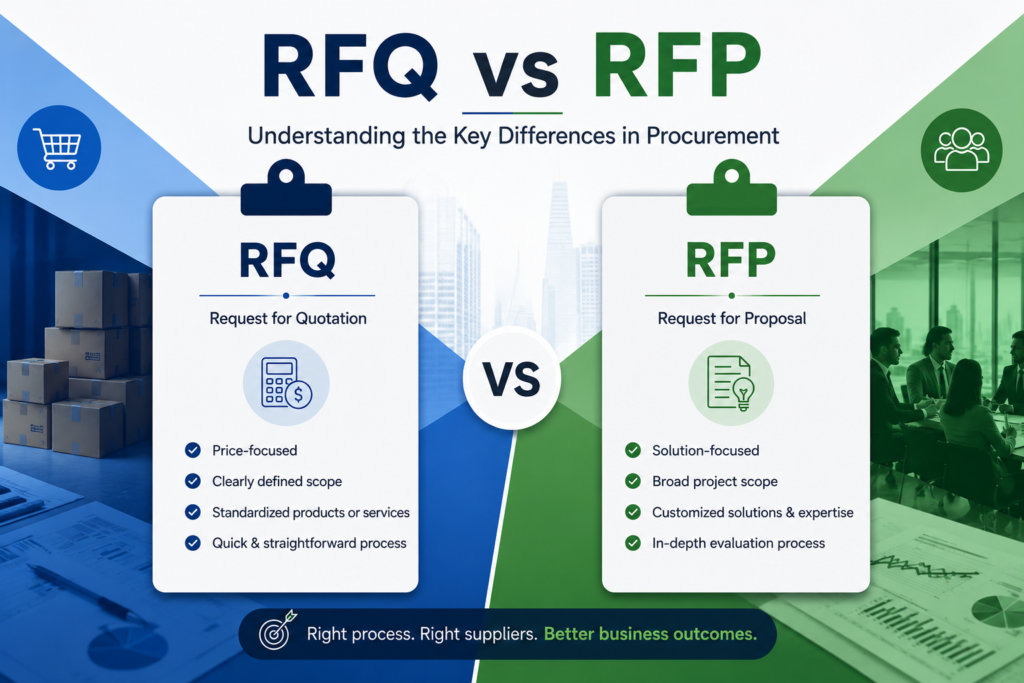
If you’ve worked in procurement for any length of time, you’ve come across both these terms. RFQ. RFP. They get used interchangeably in meetings, emails, and vendor conversations — but they’re not the same thing, and using the wrong one at the wrong time quietly costs you money, time, and sometimes vendor relationships.
This post explains both in plain terms, with real examples drawn from promotional merchandise and POSM sourcing in India — which is the kind of sourcing most of our clients at Earth Tribe are doing.
Start here: What problem are you trying to solve?
The simplest way to choose between an RFQ and an RFP is to ask yourself one question: do I already know exactly what I want?
If yes — if you have specifications, quantities, quality standards, and you just need someone to give you a price — that’s an RFQ situation. You’re not asking for ideas. You’re asking for a number.
If no — if you know the outcome you want but you’re not sure how to get there, or you need a vendor to help you figure out the best approach — that’s an RFP situation. You’re not just asking for a price. You’re asking for a solution.
Everything else about these two documents flows from that single distinction.
What is an RFQ, really?
RFQ stands for Request for Quotation. The name says it all — you’re requesting a quote. You’ve done the thinking. You’ve defined the product. You know what material you want, what size, what finish, how many units, and when you need them. You’re sending that specification to multiple vendors and asking each of them: how much will this cost me?
A good example from our world: an FMCG brand needs 50,000 branded stainless steel bottles — 750ml, with laser engraving, in individual gift boxes, delivered to a warehouse in Mumbai. The marketing team has already signed off on the design. The product manager has confirmed the quantity. The brief is locked. What the procurement team needs now is pricing from three or four suppliers so they can compare and make a decision.
That’s a textbook RFQ. The spec is fixed. The vendor’s job is to confirm they can do it and tell you what it’ll cost.
Another example: a global electronics brand that ran a display stand program last year wants to reorder the exact same units — 20,000 pieces, same design, same specs. No changes. They just want the best price for the reorder. Send an RFQ. It’ll get responses in days, the comparison is straightforward, and procurement can move fast.
The RFQ works well because it’s efficient. When everyone is quoting against the same fixed specification, you get apples-to-apples comparisons. You can rank suppliers on price, lead time, and payment terms. The whole process is clean and fast.
What is an RFP, really?
RFP stands for Request for Proposal. Here the dynamic is different. You know what you’re trying to achieve, but you’re open to — or genuinely need — the vendor’s expertise to figure out how to get there.
Think of it this way. With an RFQ, you walk into a restaurant and order a specific dish. With an RFP, you tell the chef what occasion you’re hosting, how many guests, what dietary preferences exist, and what impression you want to leave — and you ask them to propose a menu.
A real example: a European company is entering the Indian market and wants to send premium onboarding kits to their first 500 employees across seven cities. They want the kits to feel premium, reflect their brand values, include sustainable packaging, and be personalised with each employee’s name. They don’t know what products should go inside. They don’t know whether to warehouse centrally or ship directly. They don’t know the right price-per-kit for the budget they have.
This is an RFP. They write down the objective, the constraints, the budget range, and the timeline — and they invite shortlisted vendors to propose solutions. Each vendor comes back with a different recommendation. Earthtribe might propose a set of four products with specific materials and a fulfilment plan. Another vendor might propose something different. The client evaluates not just price but thinking, experience, and capability.
Another example: a cosmetics brand planning a pan-India retail activation needs custom display units, in-store branding, logistics coordination, and installation teams across 40 cities. There are too many variables for a fixed specification. The vendor’s ability to manage complexity is as important as their unit pricing. An RFP lets the brand assess all of that — not just the numbers.
The key difference, in one sentence
An RFQ evaluates price. An RFP evaluates capability.
This is why the evaluation process for an RFP is longer and more involved. You’re not just comparing spreadsheets. You’re reading proposals, assessing vendor experience, sometimes asking for presentations or samples, and scoring against multiple criteria — things like infrastructure, past project experience, quality systems, and yes, pricing too.
For an RFQ, a simple scoring matrix works: price gets the most weight, followed by delivery timeline and payment terms. For an RFP, you need a weighted scorecard that reflects what actually matters for that specific project.
The cost of using the wrong one
This is where most sourcing mistakes happen — not in execution, but in the choice of instrument.
When you send an RFQ for something that actually needed an RFP, you end up selecting a vendor based on price alone, with no visibility into whether they can actually handle the complexity. The specs you wrote weren’t comprehensive enough, so once the project starts, things come up that weren’t in the brief. Scope expands. Costs increase. Timelines slip. The vendor isn’t necessarily at fault — you asked for a price on an incomplete specification, and that’s what you got.
The reverse mistake is equally wasteful. When you run a full RFP process for a straightforward repeat order, you’re burning time and resources on a decision that could have been made in a week. Vendors spend hours writing proposals for something that didn’t need a proposal. Your team spends hours evaluating them. And you probably end up choosing the same supplier you would have chosen with a simple quote anyway.
Procurement maturity is knowing which tool to use before you start.
A practical approach for complex sourcing programs
For large or new programs in India, the most effective approach is to do both — in sequence.
Start with an RFP. Use it to shortlist two or three vendors who have the capability, experience, and infrastructure to handle the project. Once you’ve done that evaluation and have confidence in who can deliver, issue an RFQ to those shortlisted vendors for final price negotiation. You get the best of both: value assessment upfront, cost control at the end.
This is how most mature procurement teams handle annual corporate gifting programs, large POSM rollouts, and new product category sourcing. It takes more time at the start, but it dramatically reduces risk downstream.
What this means when sourcing from India
India is one of the most diverse manufacturing ecosystems in the world. Different regions specialize in different product categories. A vendor in Delhi NCR who is excellent at POSM fabrication may have no experience with apparel merchandise. A Mumbai-based supplier strong in packaging may not have the logistics infrastructure for pan-India delivery.
When you’re sourcing from India for the first time — or entering a new product category — an RFP is almost always the right starting point. It forces vendors to demonstrate their actual capabilities, not just quote a number. It surfaces questions you didn’t know to ask. And it protects you from the most common sourcing risk: a low-price quote from a vendor who wasn’t qualified to deliver.
Once you’ve qualified your vendors and established a working relationship, RFQs become your everyday tool for efficiency. You know who can do what. You’re just optimising cost and lead time from there.
The short version
Use an RFQ when the specification is complete, the quantity is known, and the decision is primarily about price. It’s fast, efficient, and gives you clean comparisons.
Use an RFP when the solution isn’t defined yet, the project has complexity, or you need to evaluate a vendor’s capabilities before committing. It takes longer but protects you from expensive mistakes.
And when in doubt — especially for new programs or new vendor relationships in India — start with an RFP, shortlist the right partners, then use an RFQ to close on price.
Earthtribe is a Delhi-based promotional merchandise and POSM partner serving FMCG, pharma, and corporate clients across India. If you have a sourcing requirement and need help structuring your brief — whether that’s an RFQ or an RFP — get in touch.