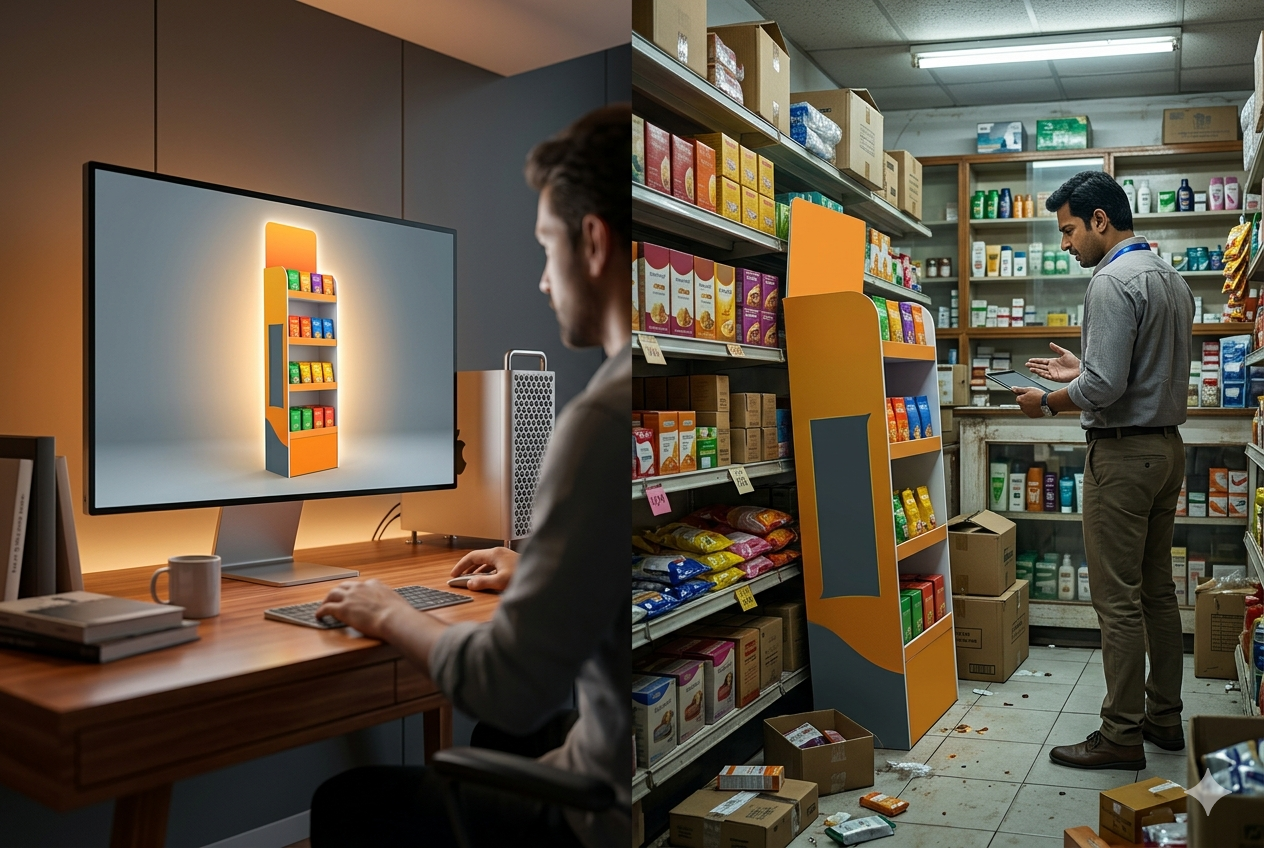
Every day, brands across India — from FMCG giants to boutique consumer labels — walk into a retail store and ask the same question: why isn’t my product getting noticed? The answer, almost always, comes down to how well they are using POSM and POP displays.
If you have ever searched “what is POSM”, “difference between POP and POS display”, “how to design a POP display that actually sells”, or “best POSM fabricator in Delhi NCR” — you are in the right place. This guide answers every question we hear from brands, marketing managers, and retail teams, and gives you the knowledge to make smarter in-store marketing decisions in 2026.
SECTION 1: THE BASICS — WHAT IS POSM AND WHAT IS A POP DISPLAY?
Q1. What does POSM stand for? What is the full form of POSM?
POSM stands for Point of Sale Materials (also referred to as Point of Sale Marketing). It is the umbrella term that covers every physical or digital marketing asset deployed inside or around a retail store to influence a shopper’s purchase decision. Think of POSM as your brand’s voice inside the store — speaking directly to a customer at the exact moment they are choosing what to buy.
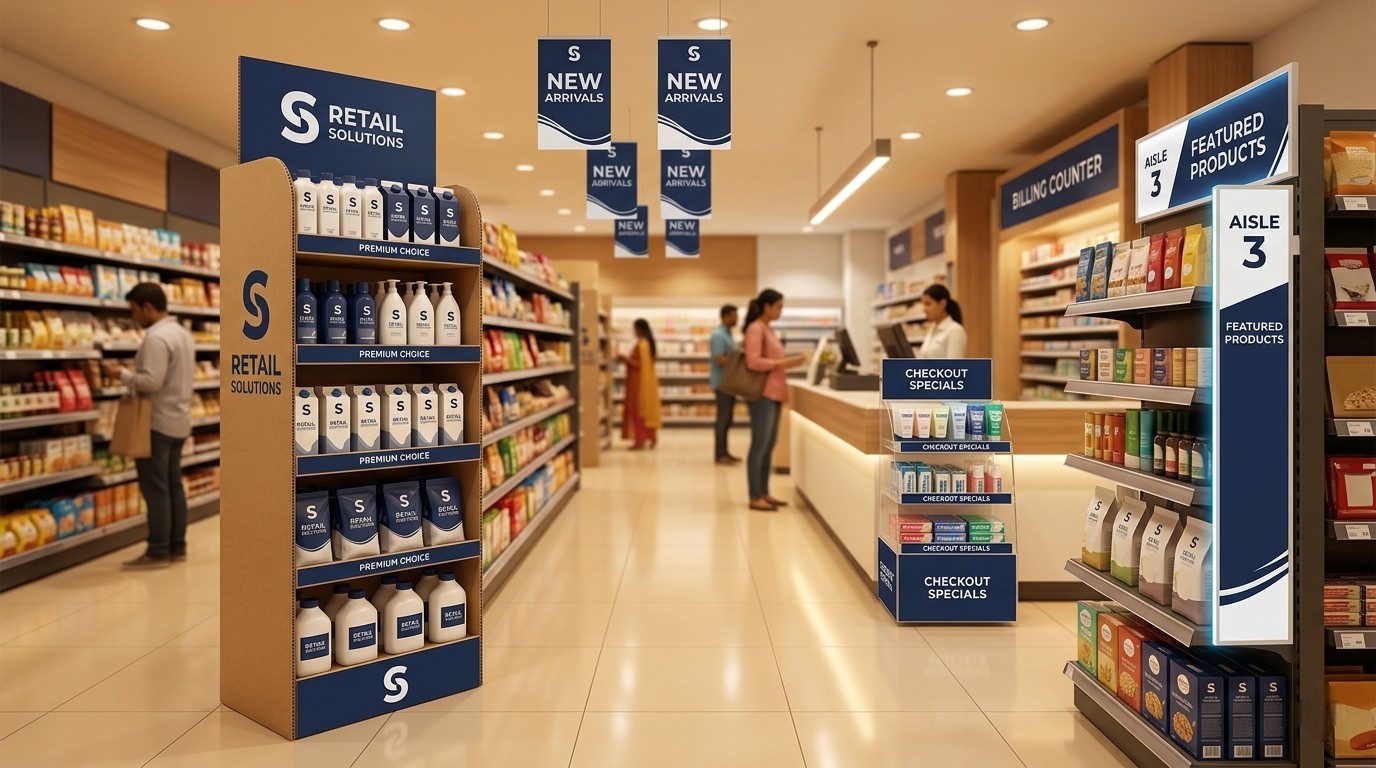
POSM includes an enormous range of formats: shelf talkers, wobblers, standees, flex banners, counter display units, floor displays, gondola branding, LED signage, danglers, table-top displays, and much more.
Q2. What is a POP display? What does POP stand for in retail?
POP stands for Point of Purchase. A POP display is a marketing display placed at or near the location where a shopper makes a buying decision — typically inside a store, near a product aisle, at an endcap, or in a high-traffic zone. POP displays are designed to intercept the shopper’s journey, create brand recall, and trigger impulse purchases.
Common POP display types include free-standing display units (FSDUs), floor standees, pallet displays, corrugated product towers, and interactive digital kiosks.
Q3. What is the difference between POSM, POP display, and POS display?
| Term | Full Form | Where It Lives | Who Controls It |
|---|---|---|---|
| POSM | Point of Sale Materials | Entire store / retail environment | Brand + Retailer |
| POP | Point of Purchase | Where buying decision is made (aisle, endcap) | Brand |
| POS | Point of Sale | Where transaction happens (checkout counter) | Retailer |
In short: POSM is the big picture. POP is about the buying decision moment. POS is about the transaction moment. Most brands use all three in a coordinated strategy.
Q4. What is the primary goal of POSM and POP displays?
The primary goal is to drive sales by influencing the shopper’s decision at the most critical moment — when they are standing in front of a product. Great POSM achieves three things simultaneously:
- Visibility: Makes your brand impossible to miss in a cluttered store environment
- Education: Communicates key product benefits, pricing, and promotions in seconds
- Conversion: Triggers impulse or planned purchases that might not have happened otherwise
Research by POPAI found that 7 out of 10 shoppers make their final buying decision inside the store. That statistic is why brands invest in POSM — because the store floor is where the real selling happens.
SECTION 2: TYPES OF POSM AND POP DISPLAYS — WHAT SHOULD YOU USE?
Q5. What are the different types of POSM materials used in retail?
POSM is a broad category. Here are the most commonly used types, broken down by location and purpose:
Floor & Aisle Displays
- Free Standing Display Units (FSDUs) — tall, independent units placed in high-traffic aisles
- Pallet displays — wraparound branding on bulk stock pallets
- Gondola end caps — branding at the end of store shelving units
- Dump bins — open bins for promotional or clearance products
Shelf-Level Displays
- Shelf talkers — small cards attached to shelf edges highlighting price or offers
- Wobblers — springy shelf-attached displays that catch the eye with movement
- Shelf strips — long horizontal branding strips along the shelf edge
- Tray inserts — product-holding trays within a shelf for premium presentation
Counter & Checkout Displays
- Counter display units (CDUs) — compact tabletop displays for impulse items near the billing counter
- Dispensers — single-product holders for candies, sachets, small accessories
- Standees — life-size or large cutout figures near checkout for brand recall
Signage & Large Format
- Flex banners and vinyl banners — outdoor-facing or in-store wide-format branding
- LED display boards and glow signs — illuminated signage for high-impact visibility
- Sunboard cutouts and ACP boards — semi-permanent signage for dealer/retail outlets
- Dangler displays — hanging displays suspended from ceilings or shelves
- Window decals and one-way vision prints — branding on store windows
Q6. What types of POP displays work best for FMCG brands in India?
For FMCG brands operating in India’s competitive retail landscape, the most effective POP display formats are:
- Corrugated cardboard FSDUs: Cost-effective, fully customisable, easy to ship flat and assemble in-store. Ideal for seasonal promotions and new product launches
- Counter display units (CDUs): Perfect for small-pack products, sachets, or impulse categories like mouth fresheners, energy bars, and OTC medicines
- Shelf talkers and wobblers: High ROI for brands that cannot afford large floor space but need price-point or variant communication
- Pallet displays: Used by large FMCG players during high-volume sales periods (Diwali, IPL season) to showcase bulk promotional packs
At Earth Tribe, we design and fabricate all of the above for FMCG brands across Delhi NCR and ship pan-India. Our materials are sourced for Indian retail conditions — humidity-resistant, structurally stable, and brand-colour accurate.
Q7. What materials are used to make POSM and POP displays?
| Material | Best For | Durability |
|---|---|---|
| Corrugated Cardboard | FSDUs, pallet displays, CDUs — temporary/seasonal campaigns | Short-term (4–8 weeks) |
| PVC Foam Board (Sunboard) | Posters, standees, shelf units — semi-permanent indoor branding | Medium (3–6 months) |
| ACP (Aluminium Composite Panel) | Dealer boards, glow sign bases, exterior signage | Long-term (2–5 years) |
| Acrylic | Premium counter displays, cosmetics, electronics showcases | Long-term (1–3 years) |
| Fabric / Mesh | Banners, outdoor displays, event branding | Short to medium |
| LED / Digital Screens | Interactive kiosks, digital POS signage, phygital displays | Long-term with maintenance |
SECTION 3: DESIGN, FABRICATION & PLACEMENT — HOW TO DO IT RIGHT
Q8. How do I design an effective POP display that actually drives sales?
The best POP display designs follow a simple but powerful framework — what we call the 3-Second Rule: your display must communicate the brand, product, and offer within 3 seconds of a shopper glancing at it.
Here are the most important design principles for high-converting POP displays:
- Brand-first hierarchy: Logo and brand colours must be instantly recognisable. Use your brand’s primary colour as the dominant background
- One dominant message: Do not try to say everything. Choose one headline — a price, an offer, or a benefit — and make it large and bold
- Product photography: Use high-resolution, lifestyle-context product images. Shoppers connect with product imagery faster than text
- Contrast and visibility: High contrast between background and text. Avoid light text on light backgrounds
- Call to action: Include a short, clear CTA — “Buy 2 Get 1 Free”, “New Flavour — Try Now”, “Limited Edition”
- Height and placement: Eye-level is buy-level. Design your display so the key message lands at the average Indian adult’s eye height (approximately 140–160 cm)
Q9. Where should POP displays and POSM materials be placed in a store?
Placement is as important as design. Here are the highest-converting locations for in-store POSM:
- Store entry zone: The first 2–3 metres of any retail store — the decompression zone — should have bold, welcoming POSM that orients the shopper and communicates key promotions
- Aisle endcaps: The most valuable real estate in any supermarket. Products placed on endcap displays see 30–40% higher pick-up rates
- Eye-level shelf positioning: Products at eye level with strong shelf talkers and wobblers outperform those on lower or upper shelves
- Checkout counters: The last opportunity to influence a purchase. Small CDUs with impulse items generate significant incremental revenue
- Near complementary categories: A POSM display placed near contextually relevant products benefits from shopper proximity intent
Q10. How do I brief a POSM fabricator? What information do they need?
When you approach a POSM and POP display fabricator like Earth Tribe, having the following details ready will result in faster timelines and better outcomes:
- Display type and format: FSDU, CDU, shelf talker, standee, banner, etc.
- Dimensions: Height, width, depth (if 3D). Specify in inches or centimetres
- Material preference: Cardboard, sunboard, acrylic, ACP, or let the fabricator recommend
- Brand guidelines: Logo files (AI/EPS/PDF), colour codes (Pantone or CMYK), approved fonts
- Product weight: Critical for structural integrity — especially for FSDUs and shelving units
- Quantity: Minimum order quantities vary by material and complexity
- Timeline: Campaign launch date, so production and delivery can be planned
- Retail location type: Modern trade, general trade, or organised retail formats have different display size norms
SECTION 4: COSTS, ROI & COMMON CONCERNS
Q11. How much do POP displays and POSM materials cost in India?
POSM costs in India vary widely based on material, complexity, finish, and quantity. Here is a general pricing reference:
- Shelf talkers / wobblers: Rs 5–50 per piece (in bulk quantities of 500+)
- Corrugated cardboard FSDUs: Rs 350–1,200 per unit depending on size and print complexity
- Counter display units (acrylic or corrugated): Rs 150–800 per unit
- Sunboard standees (3mm PVC): Rs 100–400 per sq ft including print
- LED glow sign boards: Rs 800–2,500 per sq ft depending on LED type and structure
- ACP dealer boards: Rs 600–1,500 per sq ft including fabrication and branding
At Earth Tribe, we work with both large FMCG brands and growing SME brands, and we offer flexible pricing based on your actual requirements. Get in touch for a custom quote.
Q12. What are the disadvantages of POP displays? Are there any risks?
POP displays are highly effective, but there are common pitfalls brands should be aware of:
- Poor quality materials: A flimsy FSDU that collapses or fades quickly damages brand perception. Always insist on quality-checked materials
- Overcrowded design: Too much information on a display kills its effectiveness. Less is more — one key message wins
- Wrong placement: A display in a low-traffic area of the store is wasted spend. Always negotiate for premium placement with retailers
- Ignoring store size norms: A display that is too large for a kirana store or too small for a hypermarket misses the mark
- No brand consistency: Mismatched colours or fonts across your POSM materials create a fragmented brand experience
Q13. How do I measure the ROI of my POSM and POP display investment?
Measuring POSM ROI requires comparing sales data before and after display deployment in the same stores over the same time period. Key metrics to track:
- Sales lift: Compare weekly/monthly sales volume in stores with the display vs matched stores without it
- Off-take velocity: How fast is product moving off the shelf or display unit?
- Shopper footfall and dwell time: For digital or interactive displays, use sensors or camera analytics
- QR code scans: Embed trackable QR codes on your POSM to measure digital engagement driven by in-store materials
- Retailer feedback: Talk to store managers — they will tell you which displays generate the most enquiries and pick-ups
Studies consistently show that well-designed POP displays generate 20–40% sales lifts during promotion periods, making POSM one of the highest-ROI tools in any brand’s marketing mix.
SECTION 5: POSM TRENDS IN 2026 — WHAT IS CHANGING?
Q14. What are the latest POSM and POP display trends in 2026?
The world of POSM is evolving rapidly. Here are the five biggest trends shaping retail displays in 2026:
1. Phygital POSM — Where Physical Meets Digital
Brands are embedding QR codes, AR triggers, and NFC chips into traditional print displays. A shopper scans a QR code on a shelf talker and instantly sees a product demo video on their phone. This bridge between physical and digital is called phygital retail, and it is becoming mainstream in Indian organised retail.
2. Sustainable and Eco-Friendly POSM Materials
With India’s growing focus on sustainability and Extended Producer Responsibility (EPR) regulations, brands are increasingly choosing recyclable corrugated cardboard, soy-based inks, and biodegradable substrates for their POSM. Sustainable displays also increase brand favourability among eco-conscious urban consumers.
3. Modular and Reusable Display Systems
Instead of creating single-use displays for each campaign, brands are investing in modular display frames that can be re-skinned with new graphics for each season. This reduces long-term cost and environmental impact significantly.
4. Data-Driven POSM Placement
Retail analytics using heat maps and footfall tracking are helping brands identify the highest-converting zones within each store format. POSM is no longer placed based on gut feel — it is placed based on data.
5. Personalised and Regional POSM
Brands operating across India are creating region-specific POSM — with local language copy, culturally relevant imagery, and festival-specific messaging. A display in Tamil Nadu may look very different from one in Punjab, even for the same product.
Q15. Is digital POSM replacing traditional print POSM in India?
Not replacing — complementing. Digital POSM (LED screens, interactive kiosks, digital shelf labels) is growing fast in modern trade and mall environments. However, traditional print and fabricated POSM remains essential for the vast majority of India’s retail landscape — especially general trade, semi-urban, and rural markets where digital infrastructure is limited.
The smartest brands in India use a hybrid strategy: digital POSM for premium modern trade accounts and physical POSM for general trade, and they ensure both are visually consistent.
SECTION 6: WORKING WITH A POSM PARTNER IN INDIA
Q16. How do I find a reliable POSM fabricator and supplier in India?
Choosing the right POSM partner is critical to your campaign’s success. Here is what to look for:
- End-to-end capability: Look for a vendor who handles design, fabrication, quality checking, and delivery — not just printing
- Material expertise: They should be able to recommend the right material for your display type, budget, and deployment duration
- Brand experience: Have they worked with brands in your category? Ask for a portfolio
- Quality standards: Do they have in-house quality control? Ask about colour accuracy processes
- Turnaround time: Campaign timelines are often tight. Your vendor must have the production capacity to deliver on time
- Pan-India distribution capability: If you need displays across multiple cities or states, your vendor must have logistics networks or dispatch capability
Q17. Why choose Earth Tribe for your POSM and POP display requirements in Delhi NCR?
Earth Tribe is a Delhi NCR-based fabricator and supplier of corporate branding, promotional products, and marketing materials with deep expertise in POSM, POP displays, and retail branding. Here is what sets us apart:
- Complete POSM range: From shelf talkers and wobblers to large-format LED signage and branded standees — we fabricate it all under one roof
- Brand-accurate production: We match your brand colours using calibrated printing equipment and pre-production proofs
- Flexible quantities: We work with campaign minimums and large-scale rollouts with equal attention to quality
- Fast turnaround: Our production timelines are built for India’s fast-moving campaign culture
- Retail format expertise: We understand the norms for modern trade, general trade, and organised retail
- Sustainability options: We offer eco-friendly material alternatives for brands with green packaging mandates
Whether you are launching a new product, running a seasonal promotion, or building dealer visibility across your distribution network, Earth Tribe has the expertise and infrastructure to make your POSM work.
QUICK REFERENCE: MOST SEARCHED POSM & POP DISPLAY QUESTIONS ANSWERED
| Question People Search | Short Answer |
|---|---|
| What is POSM full form? | Point of Sale Materials (or Point of Sale Marketing) |
| What is POP in retail? | Point of Purchase — where the buying decision is made |
| Difference between POP and POS? | POP = buying decision location; POS = transaction location |
| What are types of POSM? | FSDUs, standees, shelf talkers, wobblers, danglers, CDUs, banners, LED boards |
| How much do POP displays cost in India? | Rs 5 (shelf talkers) to Rs 1,200+ (large FSDUs) per unit |
| What material is best for POP displays? | Corrugated cardboard for temporary; ACP or acrylic for permanent |
| Does POSM increase sales? | Yes — well-designed POSM generates 20–40% sales lift during promotions |
| What is a shelf talker? | A small card attached to the shelf edge highlighting a product’s price or offer |
| What is a wobbler in retail? | A spring-mounted shelf display that wobbles to attract shopper attention |
| What is an FSDU? | Free Standing Display Unit — an independent floor display for products |
| Who makes POP displays in Delhi? | Earth Tribe — Delhi NCR’s POSM and POP display fabricator |
| How to design a POP display? | Follow the 3-second rule: brand + message + offer instantly visible |
Conclusion
POSM and POP displays are not just decorative elements in a store — they are strategic sales tools that convert passive browsers into active buyers. Whether you are a national FMCG brand running a pan-India campaign or a growing D2C brand building your first in-store presence, investing in the right display materials, designed and placed correctly, will deliver measurable returns.
At Earth Tribe, we have helped brands across Delhi NCR and beyond transform their retail presence through smart, well-crafted POSM. If you have a campaign coming up — or just want to explore what the right display strategy could look like for your brand — reach out to us. We would love to help you stand out.