
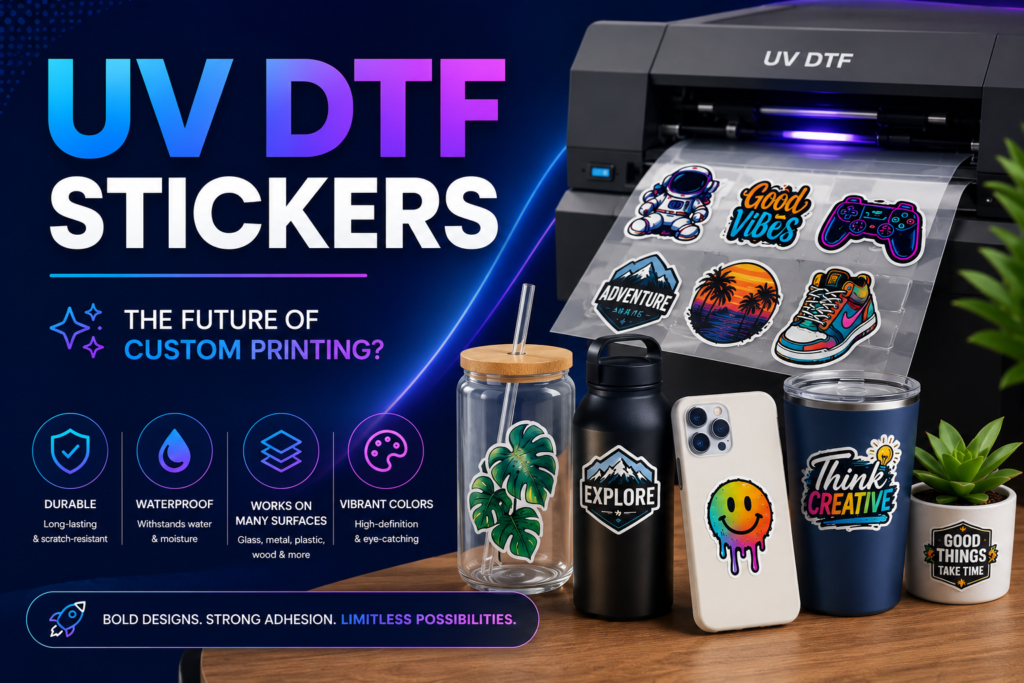
If you’ve recently placed a branding or gifting brief and someone mentioned UV DTF stickers as an option, you might have wondered what exactly sets them apart from the vinyl stickers or printed labels you’ve used before. The short answer is: quite a lot. The longer answer is what this post is about.
UV DTF is one of the more significant shifts in custom printing over the last few years — not because it replaces everything, but because it solves problems that older methods struggled with, particularly for corporate branding and promotional merchandise applications.
What UV DTF Actually Means
UV DTF stands for UV Direct to Film. It’s a two-step process. First, your design is printed onto a special transfer film using UV-curable inks — inks that harden the moment ultraviolet light hits them, rather than needing heat or time to dry. Second, a clear adhesive layer is applied over the print, which is then transferred to whatever surface you’re branding.
The result is a sticker that doesn’t just sit on the surface — it bonds to it. The ink layer is raised slightly, giving the print a tactile quality that’s closer to a label applied during manufacturing than something stuck on afterwards. For premium gifting and corporate merchandise, this finish detail matters more than most people expect. Recipients notice it, even if they don’t consciously identify what’s different.
No heat pressing is required. No weeding — which is the painstaking process of removing excess material from around vinyl-cut designs. No lamination, because the UV-cured ink is already scratch and water resistant by nature. The process is faster, cleaner, and produces a consistently professional result.
Where UV DTF Works Best
The most practical advantage of UV DTF for corporate use is surface versatility. Most printing methods are tied to specific materials. Sublimation only works on polyester-coated surfaces. Screen printing is primarily for fabric and flat boards. Standard vinyl stickers don’t adhere reliably to curved or textured surfaces.
UV DTF works on glass, metal, plastic, ceramic, leather, and wood — which means it’s compatible with the majority of surfaces used in promotional merchandise and corporate gifting. A set of branded steel tumblers, a leather notebook with a client’s company logo, a ceramic mug with a campaign design, a glass award piece with a custom graphic — all of these can be done with UV DTF without switching processes or vendors.
For procurement teams managing multi-SKU gifting programs, this is a real operational benefit. One process, one supplier, consistent finish across different product types.
The Corporate Gifting Use Case
Consider a common scenario: a pharma company is running a doctor engagement program and wants 2,000 branded sets — a steel pen, a notepad, and a coffee mug, all carrying the brand’s logo and a campaign message. The brief comes in with a two-week turnaround.
With screen printing, each product type requires its own setup and minimum order quantity. With UV DTF, the same artwork file is used across all three surfaces, setup is minimal, and small-to-medium quantities are cost-efficient. The finish is identical across items — same colour rendering, same surface adhesion, same sheen — which matters for brand consistency when multiple pieces go into a single gift set.
For marketing teams running event merchandise, retail activations, or trade show giveaways, UV DTF also removes the lamination and weeding steps that slow down traditional sticker production. Large quantities can be turned around quickly without sacrificing print quality.
Where UV DTF Has Limitations
It’s worth being direct about what UV DTF doesn’t do well, so you don’t specify it for the wrong application.
It is not suitable for fabric or apparel. The UV-cured ink layer is rigid, and when applied to stretchable materials like jersey fabric or fleece, it cracks with movement and washing. For branded t-shirts, jackets, or bags, DTF (standard Direct to Film, without the UV component) or screen printing are better choices.
On very porous or highly textured surfaces — raw wood, unfinished fabric, certain rubber compounds — adhesion can be inconsistent. Surface preparation helps, but it’s a variable worth flagging in your brief if the substrate is unusual.
Gradient-heavy designs with very subtle colour transitions can sometimes show slight banding due to how UV inks cure in layers. For most corporate branding work — logos, typography, clean graphic designs — this isn’t an issue. But for photographic prints or artwork with complex tonal ranges, dye sublimation produces smoother gradients.
These aren’t reasons to avoid UV DTF — they’re reasons to match the process to the application, which any good vendor will help you do before production starts.
UV DTF vs. the Alternatives: A Quick Reference
For procurement managers who need to compare methods quickly, here’s the practical breakdown.
Screen printing is the right choice for high-volume fabric printing where unit cost is the primary driver and the design is relatively simple — a two or three colour logo on a t-shirt, for example. Setup costs are high, which makes it uneconomical for small runs or complex multi-colour work.
Sublimation produces outstanding colour quality on polyester and coated ceramic or metal surfaces, and it’s popular for full-coverage designs on drinkware and flat merchandise. But it’s limited to compatible surfaces and doesn’t work on dark or transparent materials without a white base coat.
Standard vinyl stickers are cost-effective for basic labelling and flat-surface applications but require weeding, tend to peel at edges over time, and don’t adhere reliably to curved surfaces.
UV DTF sits above vinyl in terms of finish and durability, works across a wider range of surfaces than sublimation, and beats screen printing on flexibility and small-run economics. The tradeoff is that it doesn’t work on fabric, and the per-unit cost at very high volumes may be higher than screen printing for simple designs.
What to Specify When You Brief a UV DTF Job
If you’re raising a brief for UV DTF printing, the details that matter most are the surface material and its finish (matte, glossy, textured, curved), the quantity and whether items need to be kitted or packed individually, the design file format (vector preferred, minimum 300dpi for raster), and whether any items have white or transparent bases that require a white ink underlay.
Turnaround on UV DTF is generally faster than screen printing because there’s no plate or screen setup. For most standard corporate gifting or merchandise briefs, three to seven business days for production after artwork approval is a reasonable expectation depending on quantity.
Is It Right for Your Next Brief?
If the requirement involves branding on hard, non-porous surfaces — drinkware, packaging, stationery, tech accessories, awards, or display materials — UV DTF is worth specifying. The finish quality is consistently high, the process handles small and medium quantities well, and the surface compatibility range is broader than most alternatives.
If the requirement is primarily fabric or apparel, look at standard DTF or screen printing instead. And if the design has complex photographic gradients, ask your vendor to run a test before committing to a large run.
At Earthtribe, we do UV DTF printing as part of our in-house customisation capability alongside laser engraving, UV flatbed printing, screen printing, and embroidery. If you have a brief that involves any combination of these — or you’re not sure which process fits best — send us the requirement and we’ll advise before the order is raised.
Earthtribe is a Delhi-based promotional merchandise and POSM partner serving FMCG, pharma, and corporate clients pan-India. In-house customisation capabilities include UV DTF printing, laser engraving, UV flatbed printing, screen printing, embossing, and embroidery.